
FAST Coaching
Coaching that changes what the business does.
A leader's job is to build great teams doing amazing work that customers love and happily pay for.
Every word in that definition matters.
Not good teams — great ones. Not work that is adequate — work that is genuinely amazing. Not customers who are satisfied — customers who love what they are receiving enough to pay for it willingly, repeatedly, and without needing to be persuaded.
Most coaching approaches focus on the leader as an individual — their mindset, their communication, their personal effectiveness. FAST coaching focuses on what the leader is building. The team. The systems. The culture. The business results. That is a different kind of coaching, and it requires a different methodology.
Not good teams — great ones. Not work that is adequate — work that is genuinely amazing. Not customers who are satisfied — customers who love what they are receiving enough to pay for it willingly, repeatedly, and without needing to be persuaded.
Most coaching approaches focus on the leader as an individual — their mindset, their communication, their personal effectiveness. FAST coaching focuses on what the leader is building. The team. The systems. The culture. The business results. That is a different kind of coaching, and it requires a different methodology.
The Problem With Generic Coaching
Most coaching frameworks were not designed for an ASEAN context.
Established coaching methodologies — ICF, EMCC, and the models built on them — were developed primarily for individual leadership development in Western professional contexts. Three gaps appear when they are applied to ASEAN business coaching.
The Methodology
Coaching with CARE.™
CARE is the FAST coaching methodology — a framework for the coaching stance, not a script or a process. It describes how a FAST coach adapts to what the client and the situation require.
The Toolkit
Frameworks that move from insight to action.
A coaching conversation that produces clarity but no action is an incomplete coaching conversation. FAST coaches use a set of proprietary tools that give the work tangible structure — turning diagnostic insights into plans, and plans into the accountability structures that make change possible.
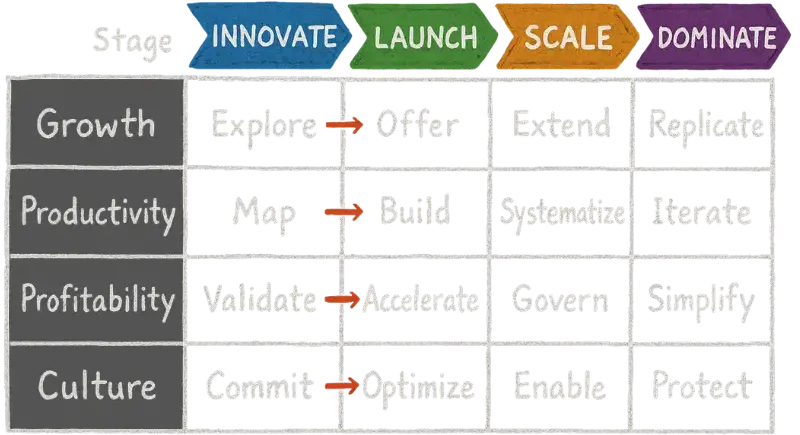
The FAST Matrix™
The diagnostic dashboard. A 4×4 grid integrating the four stages of growth with the four pillars of performance — used in coaching to build a shared, evidence-based picture of the business and identify where the most urgent work lies.

The FAST Action Plan™
The bridge between insight and execution. Translates the diagnostic conversation into a focused set of priorities, objectives, and measurable outcomes — so that the coaching produces a plan the client can act on immediately.
The FAST Playbooks
Pathway-specific working documents for each of the four pillars. Give the coaching work tangible, lasting deliverables — tools the client and their team can use independently between and beyond coaching sessions.
Positioned Differently
Designed for a different problem.
FAST coaching is not positioned against ICF or EMCC — those are rigorous frameworks for coaching practice. FAST is designed for a specific problem: the business leader in an ASEAN organisation who needs a strategic thinking partner with deep business knowledge and a methodology that moves between reflection, teaching, mentoring, and consulting as the situation demands.
For coaches who hold an ICF or EMCC credential, the Certified FAST Coach credential adds the business framework and ASEAN context those credentials do not provide. AFCSI awards the CFC as a specialist business coaching credential — complementary to ICF/EMCC rather than competing with them. The combination represents a genuinely differentiated professional profile.
Start with the
free courses.
FAST Foundations introduces the system, and Coaching with CARE introduces the methodology in practice. Both are the perfect starting point for anyone considering FAST Certification.
Learn about FAST Certification →